Via Wireless Systems
Underground mesh infrastructure for sites without reliable cable
Mines already use Wi-Fi access points underground. We call our units AP Nodes: same local job, with better ways to stay online when cable is missing, ordinary Wi-Fi fails, or site power drops. Via Node S1 can run on battery as well as AC, DC, or PoE.
Rib coverage starts with Via Node S1. Mobile equipment extends the mesh with Via Node S2. When wired backhaul is not available, Via SDR M44 carries the wireless mesh link.
How it works
One system, wired when you can, wireless when you must
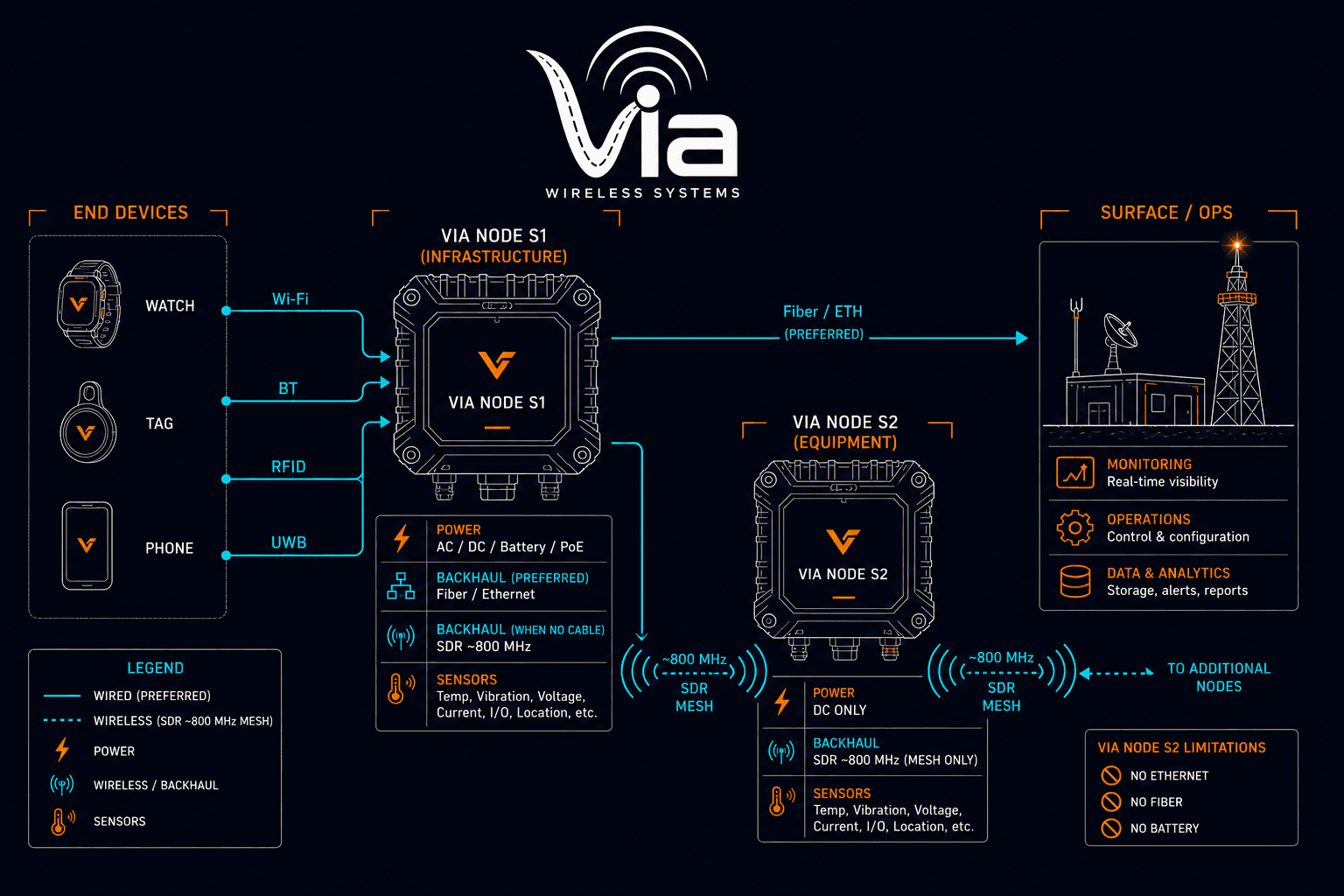
Via Node S1 (VWS-NOD-S1) is the infrastructure node. Via SDR M44 (VWS-SDR44) is the M.2 RF coprocessor inside it. Local radios connect nearby watches, tags, and handhelds. Fiber or Ethernet is preferred for backhaul between nodes and to the surface. When cable is missing, the SDR carries the mesh.
01 · Local devices
Watches, tags, and phones associate to the node over Wi-Fi, Bluetooth, RFID, and UWB paths (LoRa on the roadmap where needed).
02 · Node services
Via Node S1 aggregates traffic, runs local services, reads sensors, and fuses locate inputs at the edge.
03 · Wired backhaul (Via Node S1)
On infrastructure Via Node S1 units, when fiber or Ethernet is available, that path is preferred to the next node or the surface.
04 · SDR wireless backhaul and mesh
When cable is missing, or on Via Node S2 mobile equipment, Via SDR M44 carries the mesh. It uses a lower frequency with up to 56 MHz of bandwidth, and a 4×4 front end configured as 2×2 transmit and 2×2 receive so uplink and downlink run concurrently instead of half-duplex time-sharing. Under good conditions that supports on the order of 100–300 Mbps class links (custom PHY dependent).
Underground offerings
What the node offers underground
Capabilities stay in one product family so sites can mix local access, cable backhaul, SDR mesh, locate anchors, and sensing without stitching separate vendor stacks.
Local device access
Each node serves Wi-Fi and Bluetooth for nearby wearables and handhelds, with more backhaul options than a typical mine Wi-Fi AP.
Fiber and Ethernet daisy-chain
On Via Node S1 infrastructure units: use cable when it exists as preferred backhaul between nodes and to the surface.
Lower-frequency SDR mesh backhaul
Via SDR M44 is the wireless backhaul when cable is unavailable, and the only backhaul path on Via Node S2.
Flexible field power (Via Node S1)
Via Node S1 is designed for AC, DC, battery, and PoE so rib installs can match site power.
GPS-denied location
Rib and mobile-equipment nodes act as anchors for zone-level and close-proximity locate, with a LoRa, Bluetooth, Wi-Fi, RFID, and UWB roadmap.
Environmental sensing hooks
Climate, gas and air headers, and acoustic paths plug into both node classes for site context.
Store-and-forward resilience
When the mesh partitions, nodes retain and forward data until the path recovers.
Rugged multi-radio design
Enclosure and coexistence engineering keep local radios and the SDR path workable in one deployed unit.
Node variants
Infrastructure Via Node S1 and mobile-equipment Via Node S2
Same underground mesh, two install roles. Fixed rib installs get the full power and cable options. Mobile equipment gets a DC-powered node that extends the mesh with sensors.
Via Node S1
Infrastructure node (rib)
Full underground node for fixed rib installs. Powered by AC, DC, battery, or PoE. Prefers fiber or Ethernet for backhaul when cable is available, and uses Via SDR M44 lower-frequency wireless backhaul when it is not. Local radios, sensors, and locate fusion stay on the same unit. Part number VWS-NOD-S1.
- Power: AC, DC, battery, PoE
- Backhaul: fiber / Ethernet preferred; SDR mesh when cable is unavailable
- Local Wi-Fi / Bluetooth plus sensors and locate
Via Node S2
Mobile equipment node
Compact node for drills, loaders, haul trucks, and other mobile equipment. DC powered only. Backhaul is Via SDR M44 only, used as mesh to grow coverage where cable cannot follow the mobile equipment. Keeps the sensor suite. No Ethernet, no fiber, and no battery pack on this variant.
- Power: DC only
- Backhaul: SDR mesh only (extend the network)
- Sensors included; no Ethernet, fiber, or battery
Coverage and locate
Fixed nodes as anchors in GPS-denied space
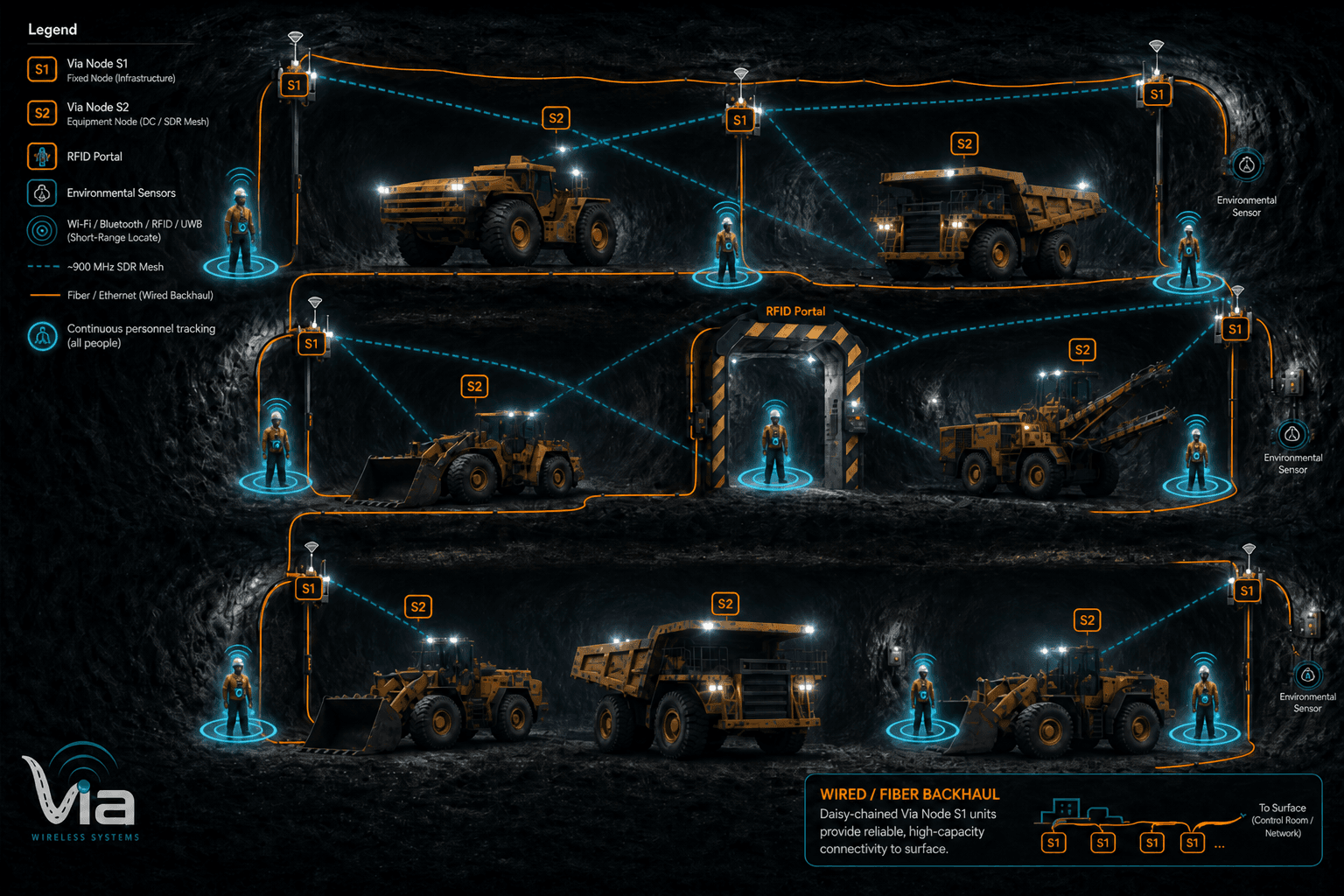
Zone-level and close-proximity location come first: known node positions, personnel nearby, fused local links, and a clear path to finer radios as the site matures.
Why it matters
Built for mines and other NLOS sites
The point is continuity: keep people, mobile equipment, and telemetry on a path when cellular is absent, mine Wi-Fi drops, or cable stops.
Beyond cellular
Nodes operate where cellular coverage does not exist underground.
More than a typical mine Wi-Fi AP
Same local access job for nearby devices, plus fiber, Ethernet, and lower-frequency SDR backhaul when ordinary APs drop.
Cable-cut continuity
Keeps video, telemetry, and tracking alive when cable is cut or never installed.
Two node roles, one mesh
Via Node S1 covers fixed rib infrastructure power and cable options. Via Node S2 rides mobile equipment on DC with SDR mesh to extend the same network.
Next step
See the hardware that makes the mesh
Start with Via Node S1 for fixed infrastructure (AC, DC, battery, PoE). Via Node S2 is the mobile-equipment DC / SDR-mesh variant on the roadmap. Via SDR M44 is the M.2 RF coprocessor shared across the mesh.